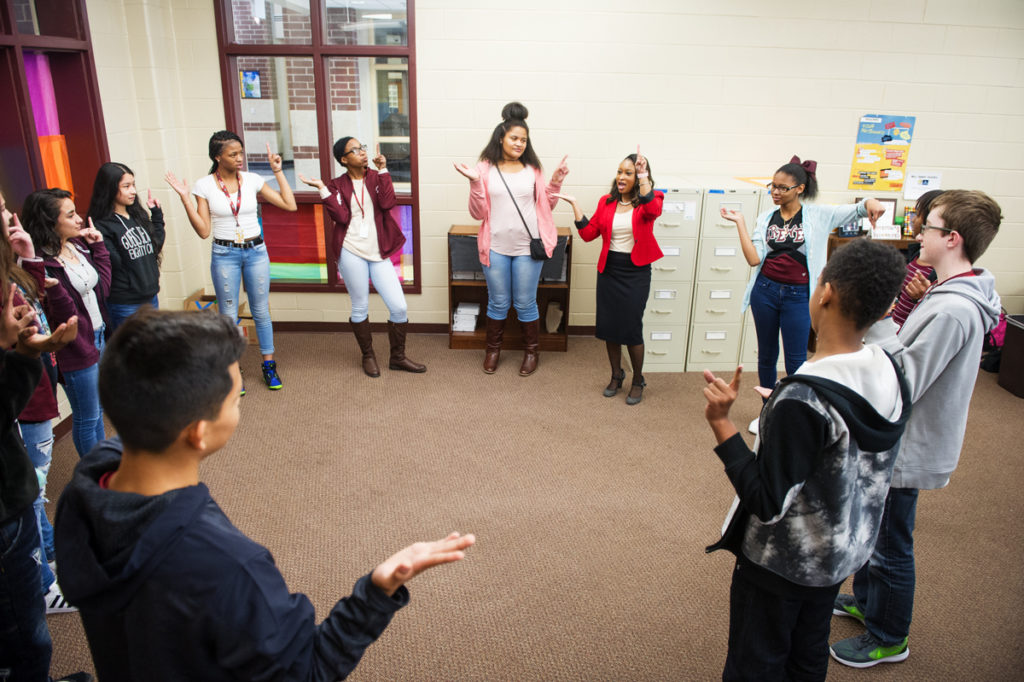
Responsive Advisory Meeting is a purposeful routine for meeting the needs of young adolescents through building positive, meaningful relationships with caring adults and peers. There are four sequential components: arrival welcome, announcements, acknowledgments, and activity.
Why Middle Schoolers Benefit from Responsive Advisory Meeting
Responsive Advisory Meeting serves as an anchor for adolescents, a predictable routine that students need more than ever as they undergo rapid physical, emotional, and intellectual changes. Advisory provides a space and structure for teachers to support middle school students, both individually and as a group, as they develop their sense of self and identity in connection to their relationships with peers.
Responsive Advisory Meeting supports middle school students of all levels of development:
- For new middle schoolers, consistency is key. While navigating a new building, adjusting to a different schedule, and mastering that right of the passage that is the locker, students find comfort and consistency in Advisory.
- For older middle schoolers, Advisory offers agency. It is a springboard from which ideas for student-led service projects arise and a meeting ground for safe, healthy debate among students engaged in learning as a community.
The Four Components of Responsive Advisory Meeting
- Arrival welcome – The teacher welcomes each student by name as they enter.
- Announcements – In advance, the teacher writes an interactive message and displays it where it can be easily seen and read by all students.
- Acknowledgments – In pairs or small groups, students share their responses to a prompt in the announcements message, a piece of news about themselves, or ideas about a topic related to their studies or interests.
- Activity – The whole group does a fun, lively activity that’s focused on the specific purpose of the meeting
Things to Remember
Responsive Advisory Meetings can be autonomous or can build on a common theme. Here are some tips for each component.
- Arrival Welcome: Use your very first Responsive Advisory Meeting to focus on names. Ask each student to introduce themselves rather than reading names off a roster. This ensures that everyone is being addressed by their preferred name (which may not match the name on your roster or may have changed since the last time students were together) and that everyone can hear the proper pronunciation of each name.
- Announcements: Communicate with digital natives digitally. If your school uses tablets or laptops, try writing the Announcement as an email or chat scheduled to send at the start of class. This also allows for more accessibility as students with visual impairments can enlarge the font and those with reading difficulty can wear headphone and listen to the message through a text reader.
- Acknowledgments: Always read the room. Keep Acknowledgements low-risk at the beginning of the year or on those not uncommon occasions when students in the group have carried an underlying social conflict into Advisory that day. A simple one-word share around the room is always an easy choice.
- Activity: Here is your chance to get students sinking their teeth into a rich content area or theme. Foster engagement by keeping the format fresh. If students are working on small group, on-going projects for a week or more, allow time for the group to break into pairs or for moments of solitary work and reflection.
The Purposes of Responsive Advisory Meeting
Advisory is designed to address seven key purposes:
- Build student to student affiliation
- Energize and re-engage
- Reflect & recalibrate
- Extend learning through themes
- Support academic readiness
- Strengthen advisor-advisee relationships
- Develop communication and social skills development
As you become more comfortable with the practice and work to design Advisories for the year ahead, keeping these purposes in mind can help to scaffold effective, engaging lesson plans for all students.
Deepen Your Impact with Responsive Classroom Professional Learning
While the Responsive Advisory Meeting is a powerful tool for building community, it is just one piece of the puzzle. To truly transform the secondary experience, teachers need a cohesive approach that spans the entire school day.
The Responsive Classroom Course for Secondary Educators goes beyond the mechanics of Responsive Advisory Meeting. IT provides a comprehensive framework for understanding adolescent development and shifting from “managing” students to motivating them. through relationship-centered discipline and autonomy-building routines, you will learn to create a space where every student feels they belong.
Why This Course is Essential for Secondary Educators
- Adolescent-Centered Design: Learn to meet the unique developmental needs of middle and high schoolers, focusing on their drive for autonomy and competence.
- Academic Engagement: Discover how to use Interactive Modeling and effective Teacher Language to boost participation in any subject area.
- Effective Discipline: Move from reactive consequences to proactive strategies that build student accountability and self-regulation.
- Sustained Community: Master the nuances of the Responsive Advisory Meeting to ensure it remains a high-point of the day for both you and your students.
By bridging the gap between developmental well-being and academic rigor, this course empowers you to create a classroom where students don’t just show up, they engage.
Explore the course details here.
Popular Articles about Responsive Advisory Meeting
Looking to introduce Responsive Advisory Meeting into your classroom or refine your current practices? Here are some of our most read articles on the subject:
Further Resources
For a more thorough exploration of this practice, including practical tips and effective ideas for each component, check out the following:
Also be sure to check our sample lesson plan and our 1-day planner with guiding questions to help you purposefully plan each component.