
Closing Circle Energizers & Activities
When I was a child, music found its way into the daily life of most elementary classrooms. My sixth grade teacher, Mr. Monahan, started each day with the pledge and the piano. He would sit down at that old black upright each morning, and we would sing a different patriotic song each day, along with several class favorites. His playing seemed effortless as he smiled and sang along with us. Mr. Monahan loved it, and so did we. Most of us remember teachers whose influence continues in our lives and in our classrooms. For me, and for my students, Mr. Monahan plays on.
As a teacher of English as a Second Language (grades K–6) and as a kindergarten teacher, music has always played an important role in my classrooms. As a consulting teacher working with Center for Responsive Schools, I’ve seen many teachers using music effectively in their teaching. While music education enhances brain development, physical coordination, language, memory, and visual and aural skills, perhaps the most important reason for filling our classrooms with music is that the ability to appreciate and enjoy music simply enhances life.
Despite the current pressure on teachers and students to accomplish more earlier, and to do it faster, there is strong rationale for the busy classroom teacher to find time for music. Here are a few ways for teachers (even those with little or no musical training) to integrate music into the daily life of their classrooms and schools:
Singing songs is a great Morning Meeting activity. Keep a list of favorite songs posted near your meeting area. Singing together builds community and enhances a sense of group competence. Choose songs that are enjoyable and comfortable for you and the children to sing. A few terrific songbook resources for lower and upper elementary grades are listed at the end of this article.
Some teachers offer students an opportunity to share the music they love at Morning Meeting. Children take turns bringing in a recording/sound file for the class to hear. Various musical styles can be explored in this way. This activity allows children to practice courteous listening and calls for respecting diverse preferences. In some middle school classrooms this is integrated more informally into the Responsive Advisory Meeting period and takes the form of casual entry music. Teachers do need to be mindful of appropriate content and discuss any concerns with children. Many controversial CDs carry a content advisory on the label, but now that music usually comes to us via streaming services as a sound file, teachers will find it wise to review selections prior to sharing.
Many teachers use songs as a ritual with which to begin or end each day. Songs can also be used for birthdays, special events, holidays, and as part of year-end and graduation/moving up ceremonies. Years ago, the Greenfield Center School, as a K–8 laboratory school, learned a variety of birthday songs. At weekly all-school meetings, the children with birthdays that week would choose one of the songs from the school repertoire to be sung to them. A favorite was the upbeat chorus from Birthday Cake, and old folk song written by John McClutcheon:
It makes me think of the good old days,
Happy birthday to you! (clap, clap)
You sure grew out of your baby ways,
Happy birthday to you! (clap, clap)
(7th) birthday, wish you many more.
Health and wealth and friends by the score.
So cut the cake and let’s eat some more.
Happy Birthday to you!
We all remember the famous alphabet song. There are many other songs which facilitate and reinforce memorization. I know a second grade teacher who uses a song to help her students remember the continents and an upper-grade teacher who uses the old song, “Multiplication Rock,” to help students learn their times tables. Many of the ESL students I taught acquired a repertoire of American folk songs while at the same time improving their pronunciation.
Music smooths transitions and soothes tempers, especially in the early elementary grades. There is a long tradition of early childhood educators using songs to support transitions and clean-up times. Whether you’re cleaning up or lining up, it’s easier with a song! A song can also be used as a signal. A kindergarten teacher I know gathers the children’s attention by singing out, “Hello, students!” using a simple melody limited to notes within the range of five-year-olds. The children stop whatever they are doing and respond, “Hello, teacher!” The power of music to support smooth transitions and other class activities is not restricted to young children. I watched a middle school teacher who routinely uses songs to support transitions, and to signal specific times of the class. His students supplied the songs, and were heard to proudly exclaim, “That’s mine! I gave him that one!”
Music in schools should not be limited to children singing songs that they have learned from teachers. Children benefit greatly from opportunities to explore melody, lyrics, and rhythms in highly individual ways. They enjoy experimenting with sound, discovering ways to create, control, and vary it. Just as children are given opportunities to explore with art materials, they need regular opportunities to explore with sound.
A great way to give primary-grade students opportunities to play with sounds is to create a music center in the classroom. My kindergarten classroom always had a theater arts center in which music figured prominently. Some early childhood teachers have a separate music center, where instruments, composition supplies, and tape recorders are made available. In these areas, I suggest providing a junk box full of objects which can be made into musical instruments, along with a good set of rhythm instruments. A variety of recorded music should also be accessible. Songbooks and sheet music can be available to introduce children to the musical symbol system. Dancing supplies, such as scarves, jingle bracelets, and ribbon sticks, are always popular.
Musical exploration is important for older children, too. They benefit from opportunities to share the music they enjoy, to write lyrics and compose, and to sing together as a group. Some of my colleagues report that once children get into third grade and beyond, they become more reluctant to participate in class singing, particularly if they perceive the songs to be childish or in some way “uncool.” While this is certainly not true in all classrooms, it happens often enough to highlight the need for alternative activities for some older children.
Older students often appreciate background music. I know one middle school teacher who has a collection of standard selections she uses as “writing music” for her students. They enjoy listening to it during class composition time. I once observed two boys in this classroom glancing at each other, shaking heads and giggling when the teacher started the music, but within a few minutes they were writing with focus, feet tapping along with the music. High school teachers have found this to work as well. Many high schools offer very successful lip-sync contests. Lip-sync practice can be one way to help older students begin to overcome their discomfort with musical participation. While they are not actually singing, they are engaging with the music.
Although these musical alternatives can be useful, there is no substitute for a group singing together, at any age. I encourage my colleagues to help children understand music as a participatory experience for everyone, rather than as performance for the gifted few.
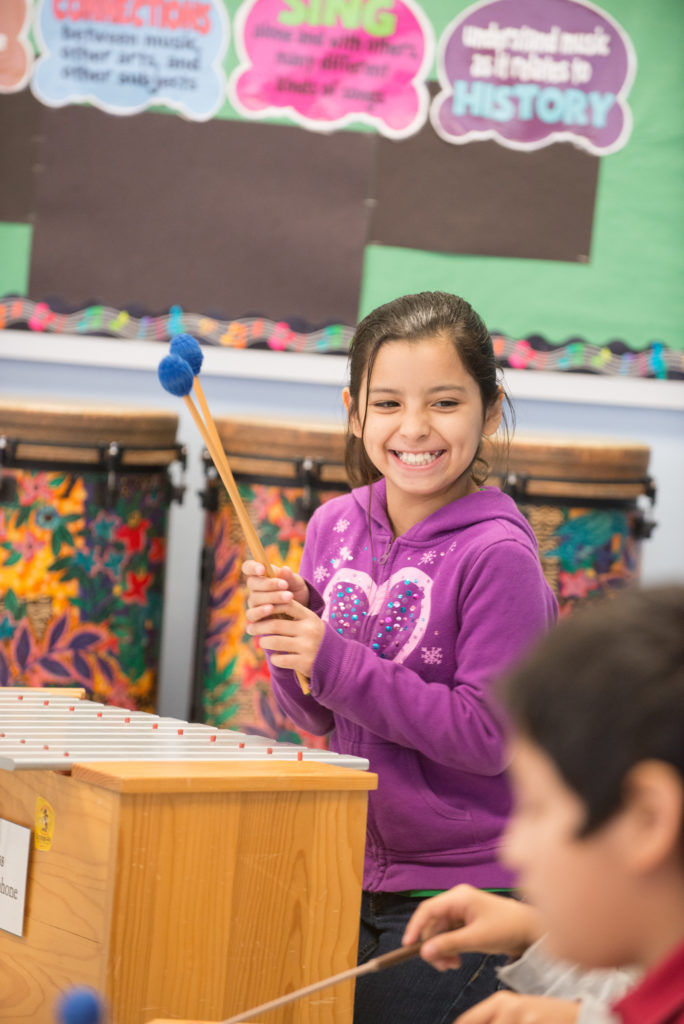
I am always amazed by what is possible when teachers work in collaboration. One year when I was teaching ESL, the music teacher planned a concert featuring musical selections from around the globe. I supplied the music teacher with a recording of the Southeast Asian children in my classroom singing a traditional Laotian folk song. She transcribed it and supplied the children with notation for the Orff instruments (xylophones, metallophones, glockenspiels).
The song was performed at the concert, complete with singers, instrumentalists, and traditional dancers in beautiful costumes. It was nothing short of magical, and I will never forget what it felt like to be there. While it took a creative and energetic music specialist to design this authentic and inventive musical event, it also required collaboration with a classroom teacher. Musical events like this can happen when classroom teachers and music specialists find the time to come together and explore possibilities.
We live in a musical world. From bird songs to the rhythm of ocean waves, we are naturally surrounded by music. Some children discover and develop musical awareness early, perhaps in homes where music is important. Some children, born musicians, find inexplicably in themselves a special passion for music and the ability to share it with others. In our classrooms and schools, all children can be given the opportunity to discover and develop an appreciation of music and how it brings people together. The children who have this opportunity every day in their schools receive a wonderful gift, and blessed are the teachers who give it. For their students, the music plays on.
The resources that follow offer practical ways to explore and incorporate music into daily classroom life.
The World of Music, a video series created by the talented Brothers Bourque, offer some innovative videos for older students to explore musical concepts. The brothers’ backgrounds in musical performance and neuroscience coupled with animation reminiscent of Monty Python makes for entertaining, sophisticated and quirky content.
The brothers are also working on games. In the works is an ear-training instrument-collecting platform adventure with challenges that teach the player how to hear, identify and play around with the fundamentals of music.
Calming Connections is a channel dedicated to creating calm, relaxing music for classroom use, along with a range of visual timers for students. Developed by an elementary/primary school teacher and mother, this channel offers purposeful sound and music videos applicable to a variety of classroom settings and lessons.
This curated playlist offers a selection of classroom-appropriate songs to support transitions, independent work time, and a positive classroom atmosphere.
Bonnie Baer-Simahk is a consulting teacher with the Center for Responsive Schools. She shared songs with children for many years in her ESL and kindergarten classrooms. Her own three children have grown up to become teachers, musicians, and musical theatre performers, sharing songs with people in their classrooms, on Broadway, and around the world!