

Graduating Happy, Healthy, Wholesome Humans.
Designed for kindergarten through grade 12, and carefully engineered to meet the needs of today’s classrooms, the new Fly Five curriculum offers a literacy-forward lesson structure, tiered supports, updated learning behavior standards, and a unified digital platform that makes daily teaching clearer, more consistent, and easier to implement.
Join the early-access list to be first to experience the new digital hub and view updated curriculum components before the launch.
Schools today need curricula that are flexible, consistent, research-aligned, and deeply supportive of academic and behavioral readiness. District leaders, principals, and teachers asked for tools that bring clarity, coherence, and connection across classrooms.
The updated Fly Five curriculum addresses these needs directly by providing a unified K–12 system that strengthens learning behaviors, discussion routines, communication, and classroom engagement.
With digital-first delivery, literacy-forward lessons, and MTSS-aligned supports, Fly Five helps educators create the conditions where students can focus, participate, communicate, collaborate, and grow every day.
A modernized K–12 system built for whole-school implementation.
Teachers use built-in reflection modules to understand their instructional tendencies, set classroom goals, and assess patterns across whole-group, small-group, and individual levels. These tools support fidelity and coherence across a district.
All instructional materials are stored in a single, secure digital hub. Teachers can launch lessons, model routines, access stories, preview vocabulary, and share school-to-home resources—all from a single platform designed for speed, clarity, and ease of use.
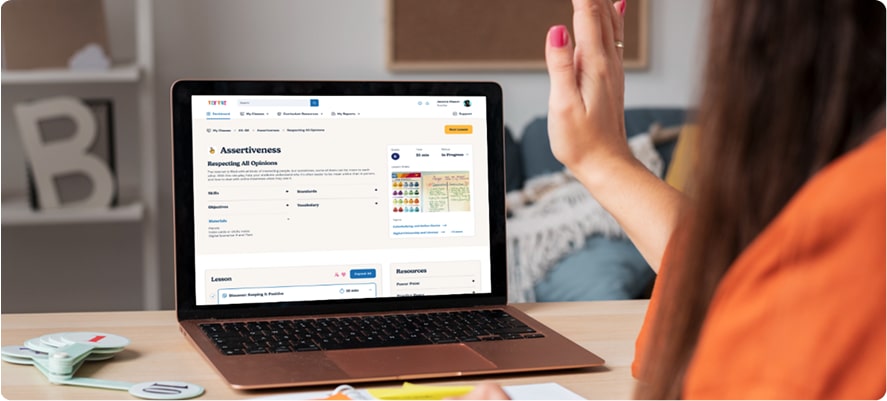
Every lesson integrates reading, speaking, listening, and reflective writing. Stories, scenarios, discussion protocols, and vocabulary supports strengthen comprehension and communication across grade levels.
Revised and expanded standards outline clear developmental expectations from kindergarten through grade 12. Observable skills define what learning behaviors look like in real classrooms, providing districts and teachers with clarity and consistency across classrooms.
Built to align with MTSS, the curriculum includes support for whole-group, small-group, and individual instruction across all grade levels.
Routines grow with students. Younger learners receive structured modeling and guided practice, while middle and high school students engage in scenario analysis, reasoning, collaborative dialogue, and structured reflection.
Mini-lessons, discussion scaffolds, reflection tools, vocabulary prompts, visual anchors, and decision-making templates help teachers differentiate instruction smoothly and effectively.

The digital platform features intuitive lesson sequencing, searchable content, pacing guidance, and simplified pathways, enabling educators to transition smoothly from modeling to discussion to reflection.
Weekly home resources mirror classroom routines and vocabulary, increasing family understanding and reinforcing learning behavior development beyond the school day.
High school teachers receive a flexible toolkit organized around five motifs: sense of self and well-being, finance and socioeconomics, relationships, decision-making, and future orientation.
These modules strengthen student communication, collaborative skills, reasoning, academic readiness, and planning for life beyond graduation.
Teachers use built-in reflection modules to understand their instructional tendencies, set classroom goals, and assess patterns across whole-group, small-group, and individual levels. These tools support fidelity and coherence across a district.
This is Fly Five’s most comprehensive, connected, and accessible curriculum yet.
The new Fly Five High School Toolkit is a flexible, teacher-led resource designed to strengthen the learning behaviors, communication skills, and academic readiness of adolescent learners. Built around five developmental motifs that reflect the realities of high school life, the toolkit provides structured supports that help students navigate identity, relationships, responsibility, and planning for the future.
Five themes anchor the curriculum:
Sense of self and well-being, finance and socioeconomics, relationships, decision-making, and future orientation. Each motif includes teacher supports and student tools that help students analyze real-world scenarios, reflect on their choices, and build skills for long-term success.
Clear guidance helps teachers facilitate discussions, scaffold complex concepts, and create space for student voice. The toolkit includes prompts, routines, and anchor structures that work across advisory, ELA, counseling, or content classes.
Students explore authentic scenarios that mirror the academic, social, financial, and personal decisions they face in high school. Through guided reflection and structured analysis, students practice evaluating options, considering consequences, and communicating their reasoning.
Graphic organizers, checklists, goal-setting templates, and reflection worksheets help students take ownership of their academic habits, personal decision-making, and future planning.
Each module can be delivered in:
Rather than offering isolated lessons, the High School Toolkit provides a structured yet adaptable set of routines, discussion frames, scenario cards, and reflection paths that help teachers cultivate communication, collaboration, responsibility, and future-ready skills in every student.
Sign up to receive early access to previews, platform tours, sample lessons, updated standards, and launch announcements.
The redesigned Fly Five curriculum is intentionally developed to complement the Responsive Classroom approach. While Fly Five stands on its own as a digital, literacy-forward, tiered K-12 curriculum, its routines and instructional design naturally reinforce the daily practices that make Responsive Classroom effective.
Together, Fly Five and Responsive Classroom offer schools a cohesive, research-aligned system for strengthening instruction, improving learning behaviors, and supporting classroom environments that foster a daily readiness to learn.
Predictable routines that mirror the structure of interactive modeling
Teacher language guidance that promotes clarity and consistency
Developmentally aligned expectations that match Responsive Classroom’s understanding of student growth
Discussion and collaboration structures that support academic engagement and community building
Tools for whole- group, small- group, and individual learning that align with MTSS frameworks
We’ll walk you through how the redesigned K–12 curriculum integrates seamlessly with Responsive Classroom practices and supports district-wide consistency.
Schedule a Fly Five and Responsive Classroom Alignment Preview
